
When several customers call your business at the same time, a single telephone line quickly becomes a problem. Calls can be missed, customers may hear a busy tone, and employees may struggle to transfer or manage conversations.
A multi line phone system solves this problem by allowing a business to handle multiple calls through a structured telephone environment.
Modern systems are no longer limited to traditional office telephones. A multi-line setup can combine SIP phones, IP PBX, VoIP, cloud telephony, call queues, extensions, call transfer, voicemail, and remote users into one business communication platform.
For companies in Pakistan, this can create a more professional and scalable way to manage calls across reception, sales, customer support, accounts, management, and multiple branches.
What Is a Multi Line Phone System?
A multi line phone system is a business telephone system that allows multiple calls to be handled through several lines, extensions, or communication channels.
Instead of giving every employee a completely separate telephone connection, the business can connect multiple users to a centralized phone system.
A typical modern setup looks like this:
SIP Trunk → IP PBX → Multi-Line IP Phones → Employees
The IP PBX manages extensions, incoming calls, outgoing calls, transfers, queues, voicemail, IVR, and other communication functions.
Each employee can have an extension while the business maintains centralized control over the entire telephone system.
How Does a Multi Line Phone System Work?
Suppose a company has a main number.
A customer calls the main number.
The system can then:
- Receive the call through SIP or another telephone connection.
- Play an IVR menu if required.
- Send the call to the correct department.
- Place the caller into a queue if all agents are busy.
- Ring one or more available extensions.
- Allow the employee to answer the call.
- Transfer the caller to another employee.
- Record the call if recording is enabled.
This process can happen automatically without requiring a receptionist to manually manage every call.
Multi Line IP Phone vs Traditional Telephone
Traditional telephone systems were designed around physical telephone lines.
Modern multi-line IP phone systems use network connectivity and SIP-based communication to provide much greater flexibility.
| Feature | Traditional Phone System | Multi-Line IP Phone System |
|---|---|---|
| Multiple extensions | Limited | Yes |
| Call transfer | Basic/limited | Advanced |
| SIP support | No | Yes |
| IP PBX integration | No | Yes |
| Voicemail | Limited | Yes |
| IVR | Limited | Yes |
| Call queues | Limited | Yes |
| Remote extensions | Difficult | Supported |
| CRM integration | Limited | Available |
| Scalability | Often limited | High |
| Central management | Limited | Yes |
For a growing company, the IP-based approach can make it easier to add users and departments without rebuilding the complete communication infrastructure.
Why Businesses Need a Multi Line Phone System
Imagine a busy office with sales, support, accounts, and management teams.
Customers call the main number throughout the day.
Without a structured phone system, employees may use separate numbers, personal mobile phones, or basic telephone lines. This can create communication gaps.
A multi-line business phone system provides a centralized alternative.
Main Benefits
A properly designed system can provide:
- Multiple simultaneous calls
- Individual employee extensions
- Call transfer
- Call hold
- Call forwarding
- Voicemail
- IVR
- Ring groups
- Call queues
- Caller ID
- Call recording
- Conference calling
- Remote extensions
- SIP trunking
- Mobile and softphone support
The result is a more organized communication environment.
Multi Line Phone System for Small Business
Small businesses do not always need an expensive enterprise telephone system.
A small office may have 5, 10, 20, or 30 employees but still require professional communication.
For example:
Main Business Number
↓
IVR
↓
Sales / Support / Accounts
↓
Individual Extensions
This setup can make a small business appear more professional while giving employees useful call-handling features.
A small business can start with a few IP phones and expand the system as the number of employees increases.
The important point is to select an IP PBX and phone models that can support future growth.
Multi Line Phone System for Offices
A larger office may need multiple departments, receptionists, managers, and shared communication resources.
A multi-line office phone system can provide centralized extensions while allowing different departments to have their own call rules.
For example:
Reception
Reception can answer the main number and transfer calls to employees.
Sales
Sales agents can have individual extensions and outbound calling access.
Customer Support
Support calls can enter a queue and be distributed among available agents.
Accounts
Accounts can have a dedicated extension or department number.
Management
Managers can have advanced phones with programmable keys, multiple SIP accounts, Bluetooth, Wi-Fi, or headset support depending on the selected model.
This structure becomes even more useful when the company has multiple branches.
Multi Line IP Phone: What Does It Mean?
A multi-line IP phone is a SIP-based business phone designed to manage multiple calls, lines, SIP accounts, or programmable line keys.
The exact capability depends on the model.
Some phones are designed for basic users, while others are built for receptionists, managers, executives, and high-volume communication environments.
For example, a business user may need only one SIP account.
A receptionist may need several SIP accounts and multiple programmable keys.
A call-center supervisor may need additional keys for monitoring, speed dialing, or extension status.
Therefore, buying a multi-line phone should begin with the user’s workflow rather than simply choosing the phone with the largest number of buttons.
Key Features to Look for in a Multi Line IP Phone
Multiple SIP Accounts
Multiple SIP accounts allow a compatible phone to register with multiple extensions or communication services.
This can be useful for receptionists, managers, and users who handle different departments.
Programmable Line Keys
Programmable keys make frequently used functions easier to access.
Depending on the model, these may be used for:
- Extensions
- Speed dial
- BLF
- Call parking
- Transfer
- Department numbers
- Frequently called contacts
Busy Lamp Field
BLF, or Busy Lamp Field, allows supported phones to display the status of extensions.
A receptionist may be able to see whether an employee is available, busy, or receiving a call.
This can make call transfers much easier.
Call Hold and Transfer
These are essential features for almost every professional office.
An employee can place a caller on hold and transfer the call to another extension.
Conference Calling
Some business IP phones support local conference calling, while larger communication systems may provide centralized audio or video conferencing.
Headset Support
For employees who spend a large part of the day on calls, headset compatibility can make the workstation more practical.
PoE Support
Power over Ethernet allows compatible phones to receive power through the network cable.
This can simplify office installation because one Ethernet connection can provide both network connectivity and power.
Popular Multi Line Phone Brands in Pakistan
Several brands are commonly used for business IP telephony.
Yealink
Yealink offers a broad range of SIP phones for small businesses, enterprises, reception desks, executives, and other professional environments.
Its portfolio includes basic, mid-range, executive, cordless, and conference communication devices.
Some Yealink models support multiple SIP accounts, programmable keys, PoE, headset connections, and Gigabit Ethernet.
Grandstream
Grandstream is another popular option for businesses looking for IP phones and PBX systems.
Its ecosystem includes IP phones, PBX appliances, gateways, networking equipment, and other communication products.
This can be useful when a company wants to build a complete VoIP infrastructure.
Fanvil
Fanvil provides SIP phones for offices, reception areas, call centers, hotels, healthcare environments, and other business applications.
Different models provide different combinations of line keys, displays, programmable buttons, PoE, headset connectivity, and SIP account support.
Cisco
Cisco IP phones are commonly associated with enterprise networking and business communications.
They can be appropriate for organizations with existing Cisco infrastructure or enterprise communication requirements.
Multi Line Phone System With IP PBX
A multi-line phone becomes much more powerful when it is connected to an IP PBX system.
The phone provides the user interface.
The IP PBX provides the centralized communication logic.
A typical architecture is:
Internet / SIP Provider
↓
SIP Trunk
↓
IP PBX
↓
Network Switch
↓
Multi-Line IP Phones
↓
Employees
The PBX can control:
- Extensions
- Call routing
- IVR
- Ring groups
- Queues
- Voicemail
- Call recording
- Call forwarding
- Conference calling
- Business hours
- Remote extensions
This is why it is important to select the phone and PBX together.
Multi Line Phone System for Call Centers
Call centers have different requirements from ordinary offices.
A call center may have dozens or hundreds of agents handling calls simultaneously.
In this environment, the system may need:
- Automatic Call Distribution
- Call queues
- IVR
- Call recording
- Agent management
- Call monitoring
- Dialers
- Real-time reporting
- Supervisor dashboards
- CRM integration
A multi-line IP phone can be used at agent or supervisor desks, while the IP PBX and call-center software handle the routing and management.
For larger deployments, businesses should also calculate concurrent calls, not just the number of extensions.
A 100-agent call center does not necessarily need 100 simultaneous calls, while a high-volume operation may require significant concurrent-call capacity.
Multi Line Phone System for Receptionists
Receptionists are among the best use cases for multi-line phones.
A receptionist may receive calls for multiple departments throughout the day.
A multi-line phone with programmable keys can make it easier to:
- Answer incoming calls
- Transfer calls
- Monitor extensions
- Use speed dial
- Park calls
- Place callers on hold
- Manage multiple conversations
A phone with BLF keys can also help the receptionist identify which employees are available.
Multi Line Phone System for Remote Employees
Modern businesses are not always limited to one office.
Employees may work from:
- Home
- Branch offices
- Customer locations
- Remote facilities
- Different cities
With a suitable cloud PBX or secure IP PBX deployment, remote employees may use compatible IP phones, desktop softphones, or mobile applications.
This allows the employee to remain part of the company’s extension system even when working outside the main office.
Security should always be considered when exposing business communication systems to remote networks.
Proper SIP configuration, firewall rules, encryption, strong authentication, and controlled access are important parts of a professional deployment.
Multi Line Phone System Price in Pakistan
The multi line phone system price in Pakistan depends on the complete solution rather than only the phone.
A basic business IP phone may be relatively affordable, while an advanced multi-line executive phone can cost considerably more.
Current IPPhone.com.pk market guidance places basic IP phones around PKR 8,000–15,000, mid-range VoIP phones around PKR 18,000–35,000, and enterprise IP phones around PKR 40,000–90,000+. Actual prices vary by model, availability, features, supplier, and warranty.
For example, current listings include the Yealink SIP-T58W Pro at approximately PKR 141,199, with features including up to 16 SIP accounts, a 7-inch color touchscreen, Bluetooth, Wi-Fi, dual Gigabit Ethernet, and PoE.
A Yealink T41P listing includes six SIP accounts, six line keys, PoE, headset support, and compatibility with major IP PBX platforms.
These examples show why the exact phone model matters when calculating the budget.
What Can Increase the Total Cost?
The complete project may include:
- IP phones
- IP PBX
- SIP trunk
- Telephone numbers
- Network switches
- PoE switches
- Headsets
- Cabling
- Installation
- Configuration
- Firewall setup
- Call recording storage
- Cloud hosting
- Maintenance
Therefore, a business should request a complete system quotation rather than comparing handset prices alone.
Multi Line Phone System vs Cloud Phone System
A traditional on-premise multi-line system places most infrastructure at the business location.
A cloud phone system moves much of the communication platform to hosted infrastructure.
On-Premise System
Best suited for businesses that want:
- Local infrastructure
- Direct hardware control
- Existing IT resources
- Custom PBX configuration
- Local network integration
Cloud Phone System
Useful for businesses that need:
- Remote extensions
- Multiple branches
- Flexible user management
- Easier deployment
- Hosted infrastructure
- Mobile and desktop communication
Neither approach is automatically better.
The right choice depends on business size, IT resources, security requirements, call volume, locations, and long-term plans.
How to Choose the Right Multi Line Phone System
Before purchasing, answer these questions.
How many users need phones?
Count current employees and expected growth.
How many calls happen simultaneously?
Concurrent calls are more important than simply counting extensions.
How many SIP accounts are required?
A receptionist or manager may need more than a standard employee.
Do you need BLF?
If reception or supervisors need to monitor extensions, BLF can be very useful.
Do you need a headset?
Call-heavy users should have compatible headset options.
Do you need PoE?
PoE can simplify installation across an office.
Is a PBX already installed?
If yes, check compatibility before buying new phones.
Do remote users need access?
If employees work remotely, confirm that the PBX supports secure remote extensions.
Do you need call recording?
Customer service, sales, and call centers may benefit from recording and reporting.
Multi Line Phone System Installation in Pakistan
Installing several IP phones is not simply a matter of connecting Ethernet cables.
A professional deployment may involve:
- Network assessment
- IP addressing
- VLAN and QoS planning
- PBX configuration
- SIP extension creation
- Phone provisioning
- BLF configuration
- Call routing
- SIP trunk setup
- Audio testing
- Security configuration
- User training
IPPhone.com.pk currently describes installation services covering extension assignment, call routing, HD voice optimization, multi-site configuration, SIP connectivity, VLAN/QoS optimization, provisioning, and troubleshooting for major IP phone brands.
For larger installations, proper planning can prevent common problems such as one-way audio, dropped calls, registration failures, jitter, and incorrect routing.
Why SIP Matters in a Multi Line Phone System
SIP, or Session Initiation Protocol, is one of the main technologies used in modern VoIP communication.
It allows compatible phones and communication systems to register with an IP PBX and establish voice calls.
A typical business system can use:
SIP Phone → SIP Extension → IP PBX → SIP Trunk → External Number
This architecture provides much more flexibility than assigning a traditional physical telephone line to every employee.
It can also make it easier to add extensions, departments, remote users, and new branches.
Multi Line Phone System for Growing Businesses
The biggest advantage of a properly designed IP phone system is scalability.
A company may start with:
10 Users → 1 PBX → 10 IP Phones
Later it may grow to:
50 Users → Multiple Departments → SIP Trunks → Call Queues
Eventually:
200+ Users → Multiple Branches → Cloud/Hybrid PBX → Centralized Management
The original communication strategy should make this growth possible without replacing everything.
This is why choosing the right PBX capacity and SIP-compatible phones at the beginning can save money over the long term.
Key Takeaways
- A multi line phone system allows businesses to manage multiple calls and extensions through a centralized communication platform.
- Modern systems commonly use SIP, VoIP, IP PBX, and network infrastructure.
- Multi-line IP phones are useful for receptionists, managers, sales teams, customer support, and call centers.
- Yealink, Grandstream, Fanvil, and Cisco are important business IP phone brands.
- Features such as multiple SIP accounts, programmable keys, BLF, PoE, headset support, and call transfer should be considered before buying.
- An IP PBX provides centralized control over extensions, routing, IVR, queues, voicemail, and other features.
- The total multi line phone system price in Pakistan depends on phones, PBX, SIP services, networking, installation, and support.
- Cloud PBX can be useful for remote employees and multi-branch businesses.
- On-premise IP PBX can provide greater local infrastructure control.
- Professional configuration is important for reliable voice quality and secure SIP connectivity.
Frequently Asked Questions
What is a multi line phone system?
A multi line phone system allows a business to handle multiple calls and users through a centralized telephone environment. Modern systems commonly use IP phones, SIP, VoIP, and an IP PBX.
What is the difference between a multi-line phone and a normal phone?
A multi-line phone is designed to manage multiple lines, SIP accounts, calls, or programmable line functions. A basic phone may be designed primarily for one user and simpler calling requirements.
Can a multi line phone work with an IP PBX?
Yes. SIP-compatible multi-line IP phones can register with compatible IP PBX systems. The PBX manages extensions, call routing, transfers, queues, IVR, voicemail, and other features.
How much does a multi line phone system cost in Pakistan?
There is no single fixed price. Basic IP phones can start in the lower price range, while advanced multi-line and enterprise models can cost significantly more. The total project also depends on the PBX, SIP trunk, network equipment, installation, and support.
Which brands are best for multi line IP phones?
Yealink, Grandstream, Fanvil, and Cisco are commonly considered for business IP telephony. The best model depends on the required SIP accounts, line keys, display, PoE, headset support, PBX compatibility, and budget.
Final Verdict
A multi line phone system is much more than a telephone with several buttons.
For a modern business, it can become the central communication layer connecting employees, departments, customers, remote workers, and branches.
The strongest setup combines the right IP phones with a suitable IP PBX, reliable SIP connectivity, proper networking, and professional configuration.
For a small office, that may mean a few affordable SIP phones and a compact PBX.
For a large company, it may mean dozens or hundreds of phones, multiple SIP trunks, call queues, IVR, recording, CRM integration, and centralized management.
The important thing is to choose the system according to users, simultaneous calls, features, network infrastructure, and future growth rather than simply buying the cheapest phone.
Contact IPPhone.com.pk
Looking for a multi line phone system in Pakistan?
IPPhone.com.pk can help businesses select IP phones, SIP phones, IP PBX systems, VoIP solutions, cloud communication platforms, and related networking equipment according to their actual requirements.
Website: IPPhone.com.pk
Email: [email protected]
WhatsApp: 03306246232
Whether you need a multi-line phone for a reception desk, a complete office telephone system, or a scalable IP PBX solution for a call center, start by discussing your number of users, expected call volume, preferred brands, and required features.
Related Posts
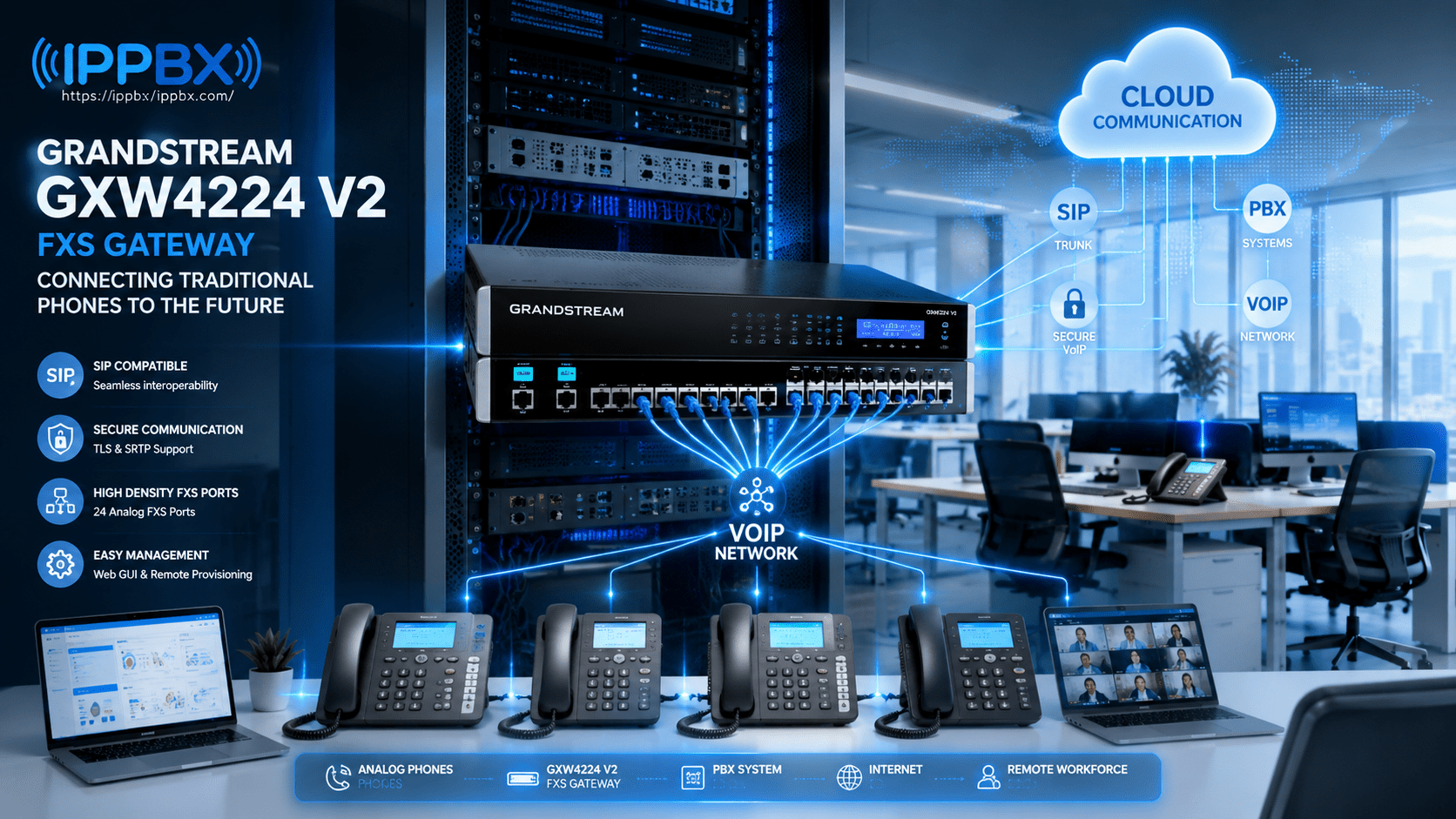
Grandstream GXW4224 V2 FXS Gateway: The Complete Guide for Modern Business VoIP
Businesses today need reliable communication systems that are easy to…
GrandStream PBX
GrandStream PBX – Complete Business Communication Solution in Pakistan Dropped…
Wireless IP Phones: Complete Guide for Businesses in Pakistan
Wireless communication has become an important part of modern business.…