
Imagine your business receives 100 customer calls every day. Some calls go unanswered, employees transfer customers manually, and your team struggles to manage communication between different departments and branches.
A traditional telephone exchange may not be enough to handle these growing communication needs.
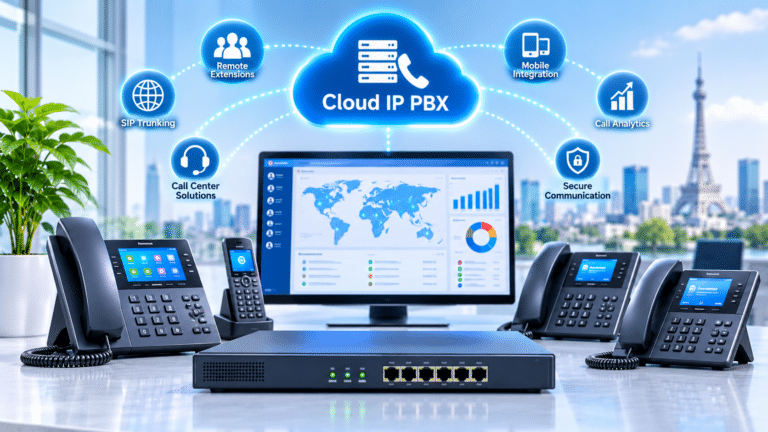
An IP PBX system provides a smarter way to manage business calls. It connects office phones, remote employees, call center agents, and external telephone networks through an IP-based communication platform.
Whether you operate a small office, a large company, a hospital, an educational institute, or a busy call center, an IP PBX can help organize your communication, reduce operating costs, and improve customer service.
If you are searching for an IP PBX system in Pakistan, this guide explains how the technology works, which brands are available, what features to consider, and how much an IP PBX costs in Pakistan.
IPPBX.com.pk provides IP PBX hardware, IP phones, VoIP gateways, SIP connectivity solutions, installation, configuration, and technical support for businesses across Pakistan.
What Is an IP PBX System? (Full Form and Meaning)
IP PBX stands for Internet Protocol Private Branch Exchange.
It is a business telephone exchange that uses an IP network to manage incoming calls, outgoing calls, internal extensions, and communication between different office locations.
Unlike traditional telephone exchanges that depend mainly on physical telephone lines, an IP PBX uses internet protocol networks and Voice over Internet Protocol (VoIP) technology to transmit voice communication.
In simple words, an IP PBX allows employees to call each other using extensions and communicate with customers through a centralized telephone system.
For example, a company can assign:
- Extension 1001 to the reception.
- Extension 1002 to the accounts department.
- Extension 1003 to sales.
- Extension 1004 to customer support.
- Extension 1005 to the management office.
Employees can communicate internally without dialing separate external telephone numbers.
The system can also route incoming customer calls to the correct department automatically.
What Is an IP PBX System and How Does It Work?
An IP PBX works by connecting telephone devices to a central PBX server or appliance through a local network or internet connection.
It uses communication protocols such as SIP (Session Initiation Protocol) to establish, manage, and terminate calls.
Here is a simple explanation of how the process works:
- An IP phone connects to the office network or a supported remote network.
- The phone registers with the IP PBX using its assigned extension and SIP credentials.
- When an employee makes a call, the IP phone sends a call request to the PBX.
- The PBX checks the extension, dialing rules, and call permissions.
- It connects the call to another internal extension or routes it through a SIP trunk or VoIP gateway.
- When the conversation ends, the PBX releases the call session.
This process allows businesses to manage multiple calls through one centralized platform.
Main Components of an IP PBX System
An IP PBX installation generally includes the following components:
1. IP PBX Server or Appliance
The central system that manages extensions, call routing, IVR, call queues, and other communication features.
2. IP Phones
Physical desk phones that connect through Ethernet or Wi-Fi, depending on the model.
Popular brands include Yealink, Fanvil, Grandstream, Cisco, and Poly.
3. SIP Trunk
A SIP trunk connects your PBX to an external telephone service provider. It allows employees to make and receive calls through public telephone networks.
4. VoIP Gateway
A gateway connects IP-based communication with traditional telephone lines, analog devices, or mobile networks, depending on its supported interfaces.
5. Network Switch and Router
These devices connect the IP phones, PBX, computers, and other network equipment.
Power over Ethernet (PoE) switches can provide both network connectivity and electrical power to compatible IP phones.
6. Internet or Local Network
The network provides communication between devices and external VoIP services.
IP PBX System Diagram: How All Components Connect
Understanding an IP PBX system diagram makes it easier to plan a reliable business telephone network.
A basic IP PBX network follows this structure:
                 INTERNET / WAN
                       |
                SIP TRUNK PROVIDER
                       |
                  FIREWALL
                       |
                 NETWORK ROUTER
                       |
                 PoE NETWORK SWITCH
                       |
              IP PBX SERVER / APPLIANCE
                       |
        ---------------------------------
        |               |               |
     IP Phones       Reception       Softphones
     Extension       Extension       Remote Users
     1001-1010         1000          Mobile / PC
        |
   Internal Calls
   IVR / Call Queues
   Call Recording
   Call Routing
In this setup, the PBX controls internal and external communication.
When a customer calls the company’s business number, the SIP trunk delivers the call to the PBX. The system can play an IVR greeting and route the caller to the relevant department.
For example:
- Press 1 for Sales.
- Press 2 for Accounts.
- Press 3 for Customer Support.
- Press 0 for Reception.
For larger businesses, multiple IP PBX systems can also be connected across different branches through secure network connections.
Important Network Requirements for IP PBX
A stable VoIP network is important for good call quality.
Before installation, consider:
- Reliable internet connectivity.
- Proper firewall configuration.
- SIP and RTP traffic handling.
- Network bandwidth.
- Low latency and jitter.
- VLAN configuration for voice traffic.
- PoE network switches.
- Network security and access restrictions.
A professional network assessment can help prevent common problems such as one-way audio, dropped calls, registration failures, and poor voice quality.
IP PBX System Price in Pakistan (2026)
One of the most common questions businesses ask is: How much does an IP PBX system cost in Pakistan?
The answer depends on the manufacturer, model, number of extensions, simultaneous calls, supported telephone lines, and required features.
An IP PBX appliance for a small office may cost considerably less than an enterprise system designed for a large call center.
The following examples are based on product prices listed on IPPBX.com.pk at the time of writing. Prices, discounts, and stock availability can change.
Current IP PBX Prices in Pakistan
| IP PBX model | Listed price (PKR) |
|---|---|
| Grandstream UCM6202 | 101,000 |
| Grandstream UCM6301 | 103,000 |
| Grandstream UCM6302 | 130,000 |
| Grandstream UCM6302A | 120,000 |
| Grandstream UCM6304 | 270,000 |
| Grandstream UCM6304A | 175,000 |
These prices represent the listed PBX hardware only. They should not be treated as complete installation quotations.
You may also need IP phones, SIP trunks, network switches, gateways, cabling, configuration, and maintenance.
Explore the latest IP PBX systems and prices in Pakistan to compare available models.
What Factors Affect IP PBX System Price?
Several factors influence the total cost of an IP PBX installation.
Number of users and extensions: A company with 10 employees has different requirements from a call center with 100 agents.
Concurrent calls: Concurrent calls represent the number of conversations the PBX can handle at the same time. This is not necessarily the same as the total number of registered extensions.
SIP trunk capacity: The number of external calls your business needs to make and receive affects SIP trunk requirements.
Analog and digital connectivity: Businesses using existing telephone lines may need FXO, FXS, or PRI/E1 interfaces or compatible gateways.
Advanced features: IVR, call recording, call queues, reporting, remote access, CRM integration, and call center functions may affect the total project cost.
Installation and support: Professional configuration, network optimization, training, and ongoing support should also be included in your budget.
For an accurate quotation, share your number of employees, expected simultaneous calls, existing telephone lines, and required features.
IP PBX Server: Hardware vs Software vs Cloud PBX
An IP PBX server is the central platform responsible for managing business telephone communication.
Businesses can deploy this platform in different ways depending on their technical requirements and budget.
1. Hardware IP PBX
A hardware IP PBX is a dedicated appliance designed specifically for business communication.
Examples include Yeastar S-Series systems and Grandstream UCM appliances.
Advantages:
- Dedicated communication hardware.
- Centralized extension management.
- Local network operation.
- Suitable for offices and business premises.
- Can provide predictable performance when properly sized.
It is a practical choice for businesses that prefer to manage their telephone system on-site.
2. Software IP PBX
A software IP PBX runs on a compatible server or virtual machine.
Platforms such as Asterisk and FreePBX allow businesses to build customizable telephone systems.
Advantages include:
- Flexible configuration.
- Custom call routing.
- Integration with business applications.
- Greater control over the server environment.
- Options for advanced call center functionality.
However, the business must consider server resources, licensing where applicable, security, backups, and technical administration.
Learn more about Software IP PBX in Pakistan.
3. Cloud IP PBX
A Cloud PBX hosts the telephone system on a cloud platform instead of requiring all PBX resources to be installed at the office.
Employees can use compatible IP phones, desktop applications, and mobile applications to connect from different locations.
Advantages include:
- Remote employee connectivity.
- Centralized communication across branches.
- Reduced need for on-site PBX hardware.
- Flexible user management.
- Easier expansion for distributed teams.
Cloud PBX is particularly useful for businesses with remote teams, multiple branches, or work-from-home employees.
IP PBX System Brands Available in Pakistan
Choosing the right manufacturer is important because different brands offer different features, capacities, interfaces, and management options.
Some of the well-known brands in the Pakistani IP telephony market include the following.
1. Yeastar IP PBX
Yeastar is a popular choice for small, medium, and growing businesses.
Its product range includes hardware PBX systems, gateways, and cloud-based communication solutions.
Common product families include:
- Yeastar P-Series.
- Yeastar S-Series.
- Yeastar Cloud PBX.
- Yeastar VoIP Gateways.
Yeastar systems are useful for businesses that need SIP extensions, IVR, call recording, remote connectivity, and centralized call management.
2. Grandstream IP PBX
Grandstream provides business communication products, including UCM IP PBX systems, IP phones, gateways, and conferencing solutions.
Its UCM series is designed to support business telephone communication and unified communication features.
Popular models include:
- Grandstream UCM6202.
- Grandstream UCM6301.
- Grandstream UCM6302.
- Grandstream UCM6304.
- Grandstream UCM6308A.
Grandstream can be a suitable option for offices and organizations that want to combine IP telephony with compatible communication devices.
3. Dinstar IP PBX
Dinstar provides VoIP communication equipment, including IP PBX systems and gateways.
Its solutions can be useful for organizations that need SIP extensions, analog connectivity, GSM connectivity, and integration with existing telephone infrastructure.
4. Cisco Business Telephony Solutions
Cisco offers enterprise networking and collaboration technologies, including business communication platforms and compatible IP phones.
Cisco equipment is commonly considered for organizations with established enterprise network infrastructure and specific integration requirements.
5. Other IP Phone and Communication Brands
Other relevant brands include:
- Yealink.
- Fanvil.
- Avaya.
- Poly.
- Zycoo.
It is important to understand that not every brand listed here manufactures the same type of product. Some specialize in IP phones, while others provide PBX platforms, gateways, or enterprise communication solutions.
Explore available IP PBX brands and products to compare equipment.
Essential IP PBX Features Every Business Should Consider
A modern IP PBX does much more than connect two telephone extensions.
It can automate communication, improve customer service, and help management monitor business calls.
Here are some useful features to consider.
Interactive Voice Response (IVR)
IVR allows callers to interact with an automated voice menu.
For example, a customer can press 1 for Sales or 2 for Support without speaking to a receptionist first.
Call Queues
Call queues place incoming callers in a waiting line when all agents are busy.
The system can distribute calls according to configured rules and agent availability.
Call Recording
Call recording helps businesses review conversations for quality assurance, staff training, and record-keeping, subject to applicable privacy and consent requirements.
Ring Groups
Ring groups allow multiple extensions to ring according to defined rules.
For example, an incoming sales call can ring three sales representatives simultaneously or in a selected sequence.
Call Forwarding
Calls can be forwarded to another extension, mobile number, or remote employee according to system rules.
Voicemail
If employees cannot answer calls, callers can leave voice messages for later follow-up.
Remote Extensions
Remote extensions allow employees to connect to the office telephone system from another location using supported IP phones or softphone applications.
CRM Integration
CRM integration can help businesses connect telephone communication with customer records, sales activities, and support workflows.
Call Reports and Analytics
Call reporting helps managers review:
- Total incoming and outgoing calls.
- Missed calls.
- Agent activity.
- Call duration.
- Queue performance.
- Call volume trends.
These reports can support better customer service and team management.
IP PBX vs Traditional PBX: Which Is Better?
Traditional PBX and IP PBX systems both manage business telephone communication, but they use different technologies.
| Feature | Traditional PBX | IP PBX |
|---|---|---|
| Communication | Traditional telephone lines | IP network and VoIP |
| Internal extensions | Yes | Yes |
| Remote extensions | More limited | Flexible with proper configuration |
| SIP trunk support | Requires compatible equipment | Commonly supported |
| Software integration | More limited | More flexible |
| Branch connectivity | May require additional infrastructure | Can use IP networks |
| Expansion | Often hardware-dependent | Depends on platform and capacity |
| Call center features | Model-dependent | Available on supported systems |
For businesses planning to expand, connect multiple branches, or integrate telephone communication with digital applications, IP PBX is often a more flexible choice.
However, the right solution depends on existing infrastructure, call volume, budget, and operational requirements.
IP PBX Installation and Configuration in Pakistan
Buying an IP PBX is only the first step. Proper installation and configuration are equally important.
A professionally configured system should be tested before employees start using it.
A typical deployment includes:
- Requirement assessment and site survey.
- Selection of a suitable IP PBX model.
- Network and internet assessment.
- PBX installation and firmware configuration.
- Creation of extensions and SIP accounts.
- IP phone provisioning.
- SIP trunk and DID configuration.
- IVR, call routing, and ring group setup.
- Security and remote access configuration.
- Testing, documentation, and staff training.
IPPBX.com.pk provides IP PBX supply, installation, configuration, IP phone setup, SIP trunk integration, and technical support.
For small office deployments, installation may be completed within one or two working days, depending on the number of extensions and network readiness. Larger multi-branch and call center projects require detailed planning.
Services can be arranged in Lahore and other locations across Pakistan, with remote configuration available for suitable deployments.
IP PBX System for Offices, Businesses and Call Centers
Different organizations have different communication needs.
Small and Medium Businesses
An IP PBX helps small offices manage reception, sales, accounts, and customer service extensions through one centralized system.
Large Companies and Multiple Branches
Businesses with several offices can connect employees through centralized communication and supported remote extensions.
Hospitals and Healthcare Organizations
Hospitals can route incoming calls to reception, appointments, billing, departments, and other relevant teams.
Educational Institutions
Universities and colleges can organize calls between administration, admissions, finance, departments, and support staff.
Call Centers
Call centers require more advanced communication features, including:
- Automatic call distribution (ACD).
- IVR.
- Agent extensions.
- Call queues.
- Call recording.
- Supervisor monitoring.
- Call reports.
- CRM integration.
- Inbound and outbound call management.
A properly designed IP PBX can provide the communication foundation for these operations.
For specialized call center requirements, explore Call Center Solutions and IP PBX Services.
Why Choose IPPBX.com.pk for IP PBX Solutions in Pakistan?
Selecting an IP PBX supplier is not just about comparing hardware prices.
You need a provider that understands your business requirements and can recommend compatible equipment, configure the system, and assist with technical issues.
IPPBX.com.pk offers a range of communication products and services for businesses in Pakistan.
Wide Range of Communication Products
The available product categories include:
- IP PBX systems.
- IP phones.
- VoIP gateways.
- FXO and FXS gateways.
- Network switches.
- Intercom phones.
- Audio and video conferencing equipment.
- Wireless networking equipment.
Multiple International Brands
Customers can explore communication equipment from Yeastar, Grandstream, Cisco, Yealink, Fanvil, Dinstar, Poly, and other manufacturers.
Professional Installation and Configuration
A suitable installation helps ensure that extensions, SIP trunks, IP phones, IVR menus, and call routing work together correctly.
Solutions for Different Business Sizes
Whether you need a small office telephone exchange or a more advanced communication platform for a call center, the system can be selected according to your requirements.
Local Technical Assistance
IPPBX.com.pk is based in Garden Town, Lahore, and supports business communication projects across Pakistan.
Customers can discuss their requirements, request quotations, and arrange technical assistance.
IP PBX System Buying Guide: How to Select the Right Model
Before purchasing an IP PBX, avoid choosing a system simply because it has the lowest price or the highest advertised extension capacity.
A suitable system should match your actual call requirements.
Use these factors when selecting a model:
| Requirement | What to check |
|---|---|
| Number of employees | Total SIP extensions |
| Busy-hour traffic | Maximum concurrent calls |
| External numbers | SIP trunk and DID capacity |
| Existing telephone lines | FXO, FXS, PRI or gateway support |
| Remote employees | Remote extension and secure access support |
| Call center | IVR, queues, recording and reporting |
| Multiple branches | Network connectivity and centralized management |
| Future expansion | Additional users and call capacity |
Example: Choosing an IP PBX for 20 Employees
Suppose you operate a company with 20 employees.
You may need:
- 20 SIP extensions.
- 5–10 simultaneous external calls.
- One reception extension.
- Sales and support ring groups.
- An IVR menu.
- Call forwarding.
- A SIP trunk with sufficient channels.
A suitable Yeastar or Grandstream model may handle these requirements, depending on its specifications and configuration.
Example: Choosing an IP PBX for a 50-Agent Call Center
A call center with 50 agents has different requirements.
You should consider:
- The maximum number of simultaneous calls.
- Inbound and outbound call traffic.
- Agent login and logout.
- Automatic call distribution.
- Call recording and storage.
- Supervisor monitoring.
- CRM integration.
- Network redundancy.
- Future agent expansion.
The system should be selected according to expected busy-hour traffic rather than the total number of registered extensions alone.
Frequently Asked Questions About IP PBX Systems
1. What is the full form of IP PBX?
IP PBX stands for Internet Protocol Private Branch Exchange. It is a business telephone exchange that uses IP networks and VoIP technology to manage internal extensions, incoming calls, outgoing calls, and communication between different office locations.
2. How does an IP PBX system work?
An IP PBX connects IP phones and softphones to a central PBX server. When a user makes a call, the phone sends a SIP request to the PBX. The system checks the extension and call rules before connecting the call to another employee or an external telephone network through a SIP trunk or VoIP gateway.
3. What is the IP PBX system price in Pakistan?
The price depends on the model, number of extensions, simultaneous calls, and features. For example, several Grandstream IP PBX models listed on IPPBX.com.pk range from approximately PKR 101,000 to PKR 270,000. IP phones, gateways, SIP trunks, installation, and configuration may add to the total cost.
4. Which IP PBX brand is best in Pakistan?
Yeastar and Grandstream are popular choices for business IP PBX installations. Dinstar is another option for businesses requiring VoIP gateways and telephony integration. The best brand depends on your user capacity, concurrent calls, connectivity, required features, budget, and support requirements.
5. What is the difference between an IP PBX server and a Cloud PBX?
An IP PBX server can run on dedicated hardware or compatible software hosted on a local or remote server. A Cloud PBX is hosted on a cloud infrastructure and allows authorized users to connect remotely. Both manage business calls, but their deployment, administration, infrastructure, and costs are different.
Key Takeaways: IP PBX Systems in Pakistan
Here are the most important points to remember:
- IP PBX means Internet Protocol Private Branch Exchange.
- It uses IP networks and VoIP to manage business telephone communication.
- A PBX can connect IP phones, softphones, SIP trunks, and VoIP gateways.
- SIP is commonly used to establish and manage calls.
- Yeastar, Grandstream, and Dinstar are popular IP PBX brands.
- Yealink, Fanvil, Cisco, and Poly are relevant IP phone brands.
- IP PBX prices depend on model, capacity, features, and installation requirements.
- Hardware, software, and cloud PBX solutions serve different business needs.
- IVR, call queues, recording, ring groups, and remote extensions improve business communication.
- Proper network configuration and security are essential for reliable VoIP services.
Conclusion: Find the Right IP PBX System for Your Business
Business communication should be simple, reliable, and easy to manage. Missed calls, disconnected branches, manual call transfers, and outdated telephone infrastructure can affect customer satisfaction and daily operations.
An IP PBX system provides a modern way to manage business communication through centralized call routing, SIP connectivity, IP phones, IVR, call recording, and remote extensions.
Whether you need a telephone exchange for a small office, a multi-branch communication network, or a complete call center setup, choosing the right hardware and configuration is important.
IPPBX.com.pk offers IP PBX systems, IP phones, VoIP gateways, SIP connectivity solutions, installation, and technical support in Pakistan.
Ready to upgrade your business telephone system?
Contact IPPBX.com.pk today. Share your number of employees, required extensions, and expected simultaneous calls. Our team can help you identify a suitable IP PBX solution and provide a quotation according to your requirements.
Contact Us – IPPBX.com.pk
Looking for an IP PBX system, business telephone exchange, VoIP solution, or professional installation in Pakistan? Get in touch with our team.
Company: IPPBX.com.pk – IP Telephony & Business Communication Solutions
Website: https://ippbx.com.pk/
Email: [email protected]
WhatsApp: +92 330 6246232
Office: 1st Floor, RB3, Awami Complex, Usman Block, Garden Town, Lahore, Pakistan.